CBSE Class 10 Maths 2026-27: MCQs, Case Study Questions & Free Test

CBSE Class 10 Maths Case Study Questions 2026-27 With Solutions | Real Board Questions
Are you preparing for CBSE Class 10 Maths 2026-27? Are you worried about 4 marks case study questions?
You are at the right place. At Galaxy Coaching Classes, we provide real board case study questions with detailed solutions so you can understand the method, not just memorize answers.
🔥 What is a Case Study Question in Class 10 Maths?
Firstly, CBSE gives you a real-life situation or a paragraph with a diagram. Secondly, it asks 3-4 sub-questions based on that situation. However, many students panic because the paragraph looks long.
On the other hand, if you know the method, these are the most scoring questions. For example, most case studies are based on polynomials, probability, coordinate geometry and mensuration.
Therefore, we have taken 2 real board questions that were asked in previous exams.
📐 Case Study 1: The Arch Problem – Polynomials [Asked in CBSE 2026 – Code 30/3/3]
This question was asked in CBSE Board 2026 – Set 30/3/3. It is a real board question from this year.
Question: During a theatre drama, a backdrop of building arches was used. The shape of the curve shown in the figure can be represented by the polynomial p(x) = -x² + 2x + 8, where x is the length (in feet) on stage level.
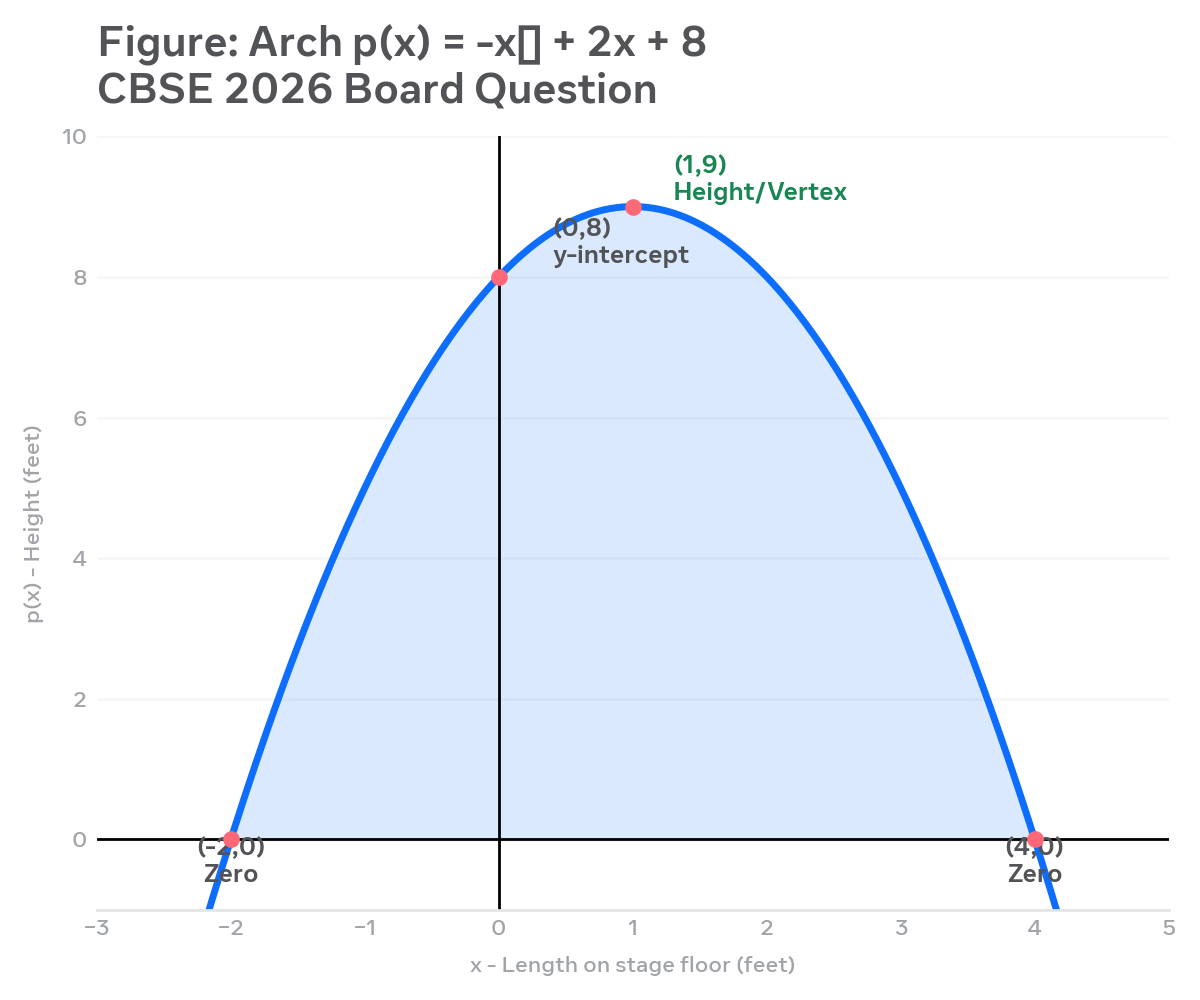
Figure: The arch touches the floor at (-2,0) and (4,0), touches y-axis at (0,8) and has max height at (1,9). This is the exact figure from CBSE 2026 question paper.
Based on the above figure, answer:
(i) Determine the height of the arch.
(ii) (a) Find zeroes of the polynomial p(x). Which points on the graph represent the zeroes?
OR (b) Find the span of the arch on the stage floor.
(iii) Write the coordinates of the point of intersection of the curve with the y-axis.
✅ Detailed Solution With Full Explanation
Step 1: Understand the polynomial
Given p(x) = -x² + 2x + 8. Since the coefficient of x² is negative (a = -1 < 0), the parabola opens downwards. Therefore, it will have a maximum point which will be the height of the arch.
(i) Height of the arch = Maximum value of p(x)
For a quadratic ax² + bx + c, maximum is at x = -b/2a.
Here, a = -1, b = 2
So, x = -2 / (2 * -1) = -2 / -2 = 1
Now put x=1 in p(x):
p(1) = -(1)² + 2*1 + 8 = -1 + 2 + 8 = 9
Therefore, height of arch = 9 feet.
(ii) (a) Zeroes of p(x)
To find zeroes, put p(x) = 0
-x² + 2x + 8 = 0
Multiply by -1: x² – 2x – 8 = 0
Now factorize: x² – 4x + 2x – 8 = 0
x(x-4) + 2(x-4) = 0
(x-4)(x+2) = 0
So, x = 4 and x = -2 are zeroes.
On the graph, these are the points where the arch touches the stage floor, i.e., (-2, 0) and (4, 0) as shown in the figure above.
(ii) (b) Span of the arch [OR Part]
Span = Distance between two zeroes = 4 – (-2) = 6 feet
Therefore, span = 6 feet.
(iii) Intersection with y-axis
On y-axis, x = 0. So put x=0 in p(x):
p(0) = -0 + 0 + 8 = 8
Therefore, coordinate is (0, 8) as you can see in the figure.
🎲 Case Study 2: Playing Cards – Probability [CBSE Official Question Bank]
This case study was published by CBSE in its official question bank for board practice.
Question: On a weekend, Rani was playing cards with her family. The deck has 52 cards. If her brother drew one card at random:
(i) Find the number of black face cards.
(ii) Find the probability of getting a king of red colour.
(iii) Find the probability of getting a face card.
(iv) Find the probability of getting a jack of hearts.
✅ Detailed Solution With Full Explanation
Step 1: Understand total cards
Total cards = 52
Black cards = 26 (13 clubs + 13 spades)
Red cards = 26 (13 hearts + 13 diamonds)
Face cards = Jack, Queen, King = 3 per suit = 12 total
(i) Number of black face cards
In black suits, face cards = J, Q, K of clubs + J, Q, K of spades = 6
Therefore, answer is 6.
(ii) Probability of king of red colour
Red kings = King of hearts + King of diamonds = 2
Probability = Favourable / Total = 2 / 52 = 1 / 26
Therefore, probability = 1/26.
(iii) Probability of getting a face card
Total face cards = 12
Probability = 12 / 52 = 3 / 13
Therefore, probability = 3/13.
(iv) Probability of jack of hearts
There is only 1 Jack of hearts in a deck
Probability = 1 / 52
Therefore, probability = 1/52.
🎯 How to Solve ANY Case Study in 5 Steps [2026-27]
- Firstly, read the paragraph slowly and underline the numbers and diagram.
- Secondly, identify the topic. For example, is it polynomial, probability or AP?
- Thirdly, write down what is given and what is asked separately.
- After that, use only the formula of that topic. Because of this, you won’t get confused.
- Finally, solve part-wise and check if your answer makes sense.
Moreover, don’t be scared by the length of the paragraph. Instead, focus on the figure and the numbers given in it.
💻 Take FREE Case Study Test on Galaxy Coaching Classes
Reading solutions is useful. However, solving yourself is much better. Therefore, practise now.
❓ FAQs
Q1. How many case study questions in Class 10 Maths 2026-27?
Currently, there are 3 case study questions of 4 marks each in Section E. Therefore, 12 marks are from case studies. Moreover, you should check official sample paper on cbseacademic.nic.in.
Q2. Are these case studies from previous board exams?
Yes. Firstly, Case Study 1 with p(x) = -x²+2x+8 is from CBSE 2026 Board Code 30/3/3. Secondly, Case Study 2 is from CBSE official question bank published for board practice. Therefore, both are real board-level questions.
Q3. Where can I practise more case study questions for free?
You can practise all case study questions with solutions for free on Galaxy Coaching Classes official website galaxycoachingclasses.in.
Leave a Reply